
Not Everyone Is Equal
Modern society tells us everyone is equal in every way—but is that true? In this blog, I explore the difference between being equal before God and the law versus being equal in wisdom, ability, character, faith, and culture. Our value as human beings is equal, but our choices, attitudes, and the gifts God has given us are not. Rather than comparing ourselves to others, we should cultivate gratitude, develop our God-given talents, and pursue wisdom through a closer relationship with Him. True fulfillment isn't found in demanding equality of outcomes—it's found in becoming the person God created you to be.
DEPRESSIONRESPECTBIBLICAL WISDOMSPIRITUAL GROWTHGODBABELEVILFATHERSWISDOMCHRISTIANPURPOSEMEN
7/25/20263 min read
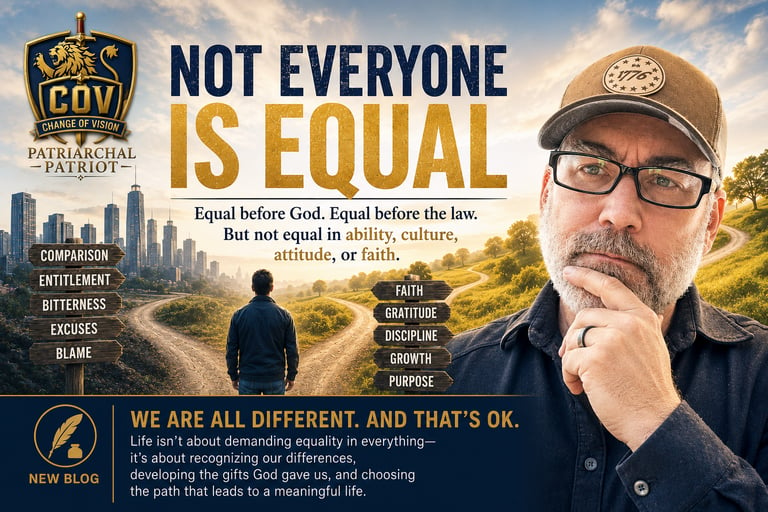
Not Everyone Is Equal
One of the most common ideas repeated in modern society is that everyone is equal. It sounds compassionate. It sounds fair. But like many popular slogans, it depends entirely on what we mean.
If we're talking about equal rights under the law, then absolutely. Every person should receive equal protection, equal justice, and equal dignity as a human being. That principle is foundational to a free society.
Can money influence outcomes? Of course it can.
Someone with significant wealth can often hire more experienced attorneys, access better medical care, live in safer neighborhoods, and provide possibly better opportunities for their children. Wealth opens doors that poverty often cannot. Although poverty can sometimes ignite a desire that privilege often cannot. The O.J. Simpson trial is frequently cited as an example of how enormous financial resources can affect a legal defense. That's primarily a matter of wealth and access—not race.
The wealthy generally have advantages that poorer people do not: larger homes, newer vehicles, better healthcare, stronger professional networks, and greater financial security.
That doesn't mean corruption should be tolerated. Wealth should never be allowed to purchase politicians or justice. But that's a different conversation.
The Danger of Comparison
Many people spend their lives comparing themselves to those who have more.
They see someone else's success and conclude life has treated them unfairly. They begin believing they deserve what someone else has earned. Gratitude disappears, and resentment takes its place.
The tragedy is that even if people with this mindset suddenly became wealthy, many would still be unhappy.
Why?
Because the problem was never their bank account.
The problem was within.
A person without gratitude will always find something missing. Someone who never learns contentment often loses appreciation for what they already have—and sometimes loses those blessings altogether.
We Are Not All Given the Same Starting Point
Every one of us enters this world differently.
We're born into different families.
Different financial situations.
Different communities.
Different challenges.
Different opportunities.
Different natural abilities.
Yet history is filled with stories—especially here in the United States—of people who began with almost nothing and built remarkable lives through faith, perseverance, discipline, and responsibility.
It's also filled with stories of people born into wealth and privilege who squandered everything they inherited.
Your starting point does not determine your destination.
God Gives Different Gifts
Every person has talents given by God.
Some discover them as children.
Others don't recognize them until much later in life.
Some never discover them at all because they spend their lives blaming everyone else instead of developing themselves.
Each person has been entrusted with different gifts and different responsibilities.
That doesn't make one person more valuable than another.
But it does mean we are not identical.
Wisdom Doesn't Come With Age
One of the greatest misconceptions is that getting older automatically makes someone wiser.
Experience often comes with age.
Wisdom does not.
I've met young adults who were calm under pressure, slow to anger, humble enough to learn, and remarkably mature.
I've also met people twice their age who were easily offended, constantly defensive, obsessed with proving themselves, and consumed by trivial conflicts.
Years lived do not produce wisdom.
A relationship with God does.
Scripture teaches us that "the fear of the Lord is the beginning of wisdom." Wisdom grows through humility, repentance, self-examination, and a willingness to submit ourselves to truth rather than our emotions.
Equality Has Limits
Modern culture often insists that all cultures are equal.
They are not.
Cultures that encourage responsibility produce different outcomes than cultures that encourage dependency.
Cultures that honor marriage, family, honesty, hard work, and self-control generally flourish more than cultures that celebrate chaos, resentment, entitlement, or moral confusion.
Likewise, not every attitude is equal.
Not every belief is equal.
Not every decision is equal.
Not every character is equal.
Some people choose discipline.
Others choose excuses.
Some seek truth.
Others seek validation.
Some pursue God.
Others pursue themselves.
Those choices matter.
The Equality That Matters Most
Before God, every human being stands on equal ground.
We all fall short.
We all need grace.
We all need forgiveness.
Before the law, every citizen should be treated equally.
But beyond those truths, pretending everyone possesses the same character, wisdom, maturity, ability, faith, or culture ignores reality.
People are different.
Some are more disciplined.
Some are more faithful.
Some are more trustworthy.
Some are more competent.
Some are more mature.
Recognizing these differences is not prejudice—it is simply acknowledging reality.
Our responsibility is not to demand that everyone be the same.
Our responsibility is to develop the gifts God has given us, cultivate wisdom, walk in humility, and become the person He created us to be.
That is where true greatness begins.
Connect
Join the conversation and support our mission
Created by Eric Forth
Faith. Family. Order. Truth
Stay grounded with updates on faith and leadership to receive a free newsletter.
© 2025. All rights reserved.
Disclaimer: I am not a doctor or licensed medical professional. Content on this site is for informational and personal growth purposes only and should not be considered medical advice.o